
2 October 2026
Can Physiotherapy Help De Quervain's? What to Expect From Assessment and Rehabilitation

If you have sharp pain on the thumb side of your wrist, gripping a mug, lifting a child, opening a jar or turning a door handle can suddenly become difficult.
You may have been told it is De Quervain's tenosynovitis and are now wondering: Can physiotherapy help, or will I eventually need an injection or surgery?
The honest answer is that many people improve with conservative care, including physiotherapy, activity changes and temporary support. However, results vary. Some people need additional medical treatment, such as a corticosteroid injection, and surgery may be considered for persistent symptoms after other options have been tried.
A sensible first step is a careful assessment and a treatment plan that is adjusted to your symptoms, work and daily routine.
What is De Quervain's tenosynovitis?
De Quervain's affects two tendons that run along the thumb side of the wrist:
- The abductor pollicis longus
- The extensor pollicis brevis
These tendons pass through a narrow tunnel near the wrist. When the tendon sheath becomes thickened or the tendons do not glide easily, movements of the thumb and wrist can become painful.
Symptoms often include:
- Pain or tenderness near the base of the thumb
- Pain with gripping, pinching, lifting or twisting
- Discomfort when moving the wrist towards the little-finger side
- Swelling or fullness near the wrist
- Reduced grip or pinch strength
- Pain when lifting a baby, using tools or completing repetitive hand tasks
It is sometimes called "mother's thumb" because it can occur after pregnancy or during early childcare. It can also affect people whose work or hobbies involve frequent gripping, lifting, texting, keyboard use or thumb movements.
Although the name includes "tenosynovitis", De Quervain's is often more accurately understood as a tendon and tendon-sheath problem involving thickening and restricted movement, rather than simple inflammation alone.
Why an accurate diagnosis matters
Thumb-side wrist pain does not always come from De Quervain's.
Other possible causes include:
- Osteoarthritis at the base of the thumb
- A wrist or scaphoid fracture, particularly after a fall or direct injury
- Irritation of a nearby nerve
- Intersection syndrome, which affects a different area of the wrist
- Other tendon problems
- Referred symptoms from the neck or upper limb
During an assessment, your physiotherapist may ask when the pain started, what activities aggravate it and whether there was an injury. They may examine your thumb and wrist movement, grip, pinch strength and the location of any tenderness.
Specific clinical tests may be used, but these should be performed carefully. A painful test does not automatically confirm De Quervain's. Your physiotherapist may also assess your neck, elbow and the rest of your upper limb if your symptoms suggest that the pain could be referred from elsewhere.
Imaging is not always necessary. Your doctor may recommend an X-ray if there has been trauma or if arthritis or a fracture needs to be ruled out. Ultrasound can sometimes help when the diagnosis is uncertain, symptoms persist or an injection is being considered.
What can physiotherapy do?
Physiotherapy is not about simply stretching the wrist and hoping the pain disappears. A good plan usually combines education, load management, support and gradually progressed exercise.
1. Activity modification and relative rest
Complete rest is not always practical or necessary. Instead, your physiotherapist may help you identify the activities that are repeatedly irritating the tendons and find ways to reduce the load temporarily.
This may include:
- Taking breaks from repetitive hand tasks
- Reducing forceful pinching
- Avoiding sustained wrist positions that increase pain
- Changing how you hold a phone, tool or child
- Alternating hands where appropriate
- Breaking larger tasks into smaller stages
The aim is relative rest: doing enough to maintain everyday function without repeatedly provoking sharp or escalating pain.
2. Lifting and gripping advice
Small technique changes can sometimes make a difference.
For example, when lifting, you may be advised to:
- Keep your wrist closer to neutral rather than bent to the side
- Use both hands for heavier objects
- Hold loads closer to your body
- Avoid lifting with the thumb spread widely and the wrist angled
- Use your palm and larger joints rather than relying on a tight pinch grip
For new parents or carers, your physiotherapist can look at how you lift, carry and reposition a child. If your symptoms are work-related and covered by a workers compensation claim, your physiotherapist may also give advice about tools, manual handling, breaks and temporary duties.
3. Splinting or taping
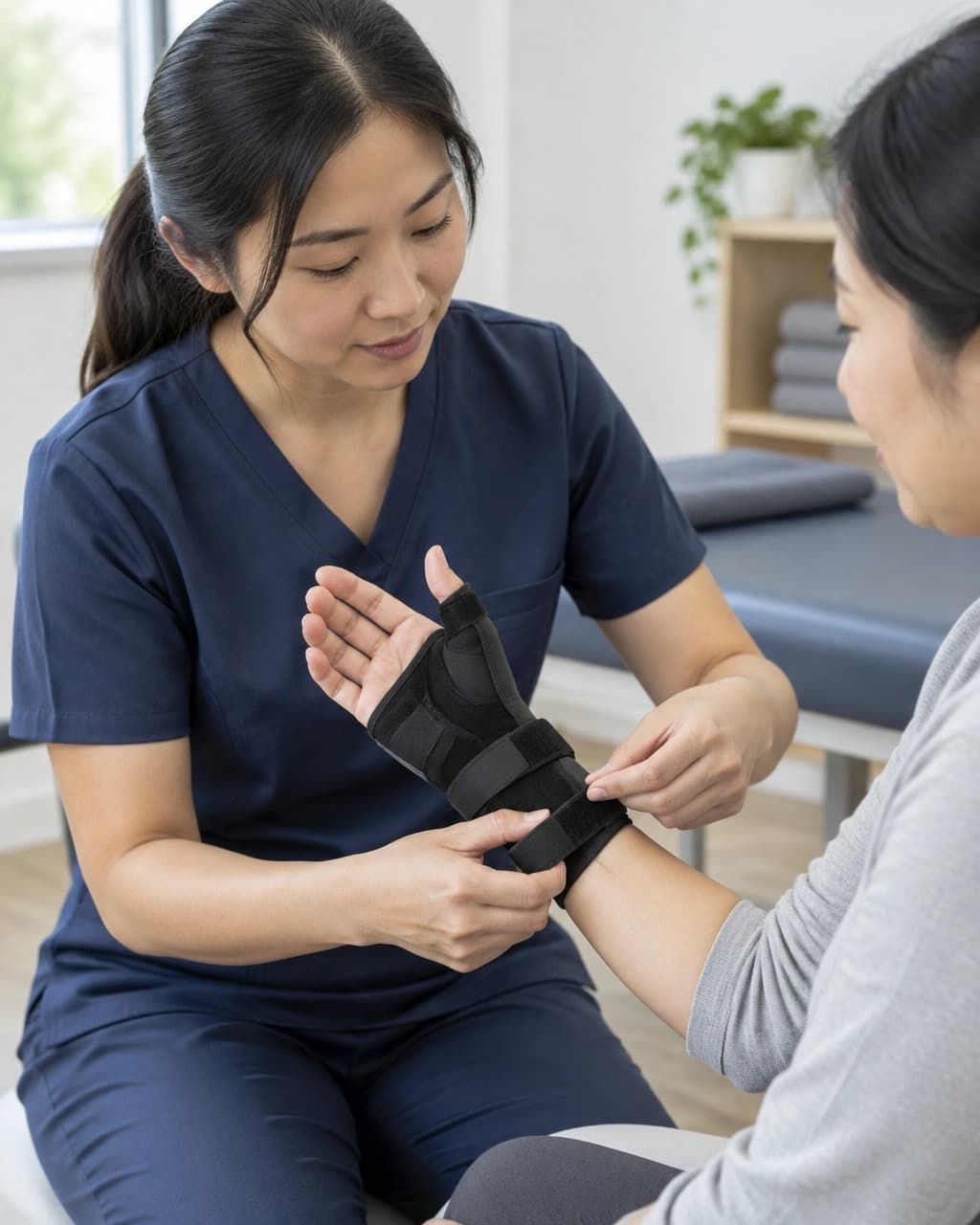
A temporary thumb-spica splint can reduce movement through the thumb and wrist while irritated tissues settle. Some people find a splint particularly useful during sleep, work or activities that are difficult to modify.
Splints should not automatically be worn forever. The type, duration and timing should suit your symptoms and goals. Your physiotherapist may also use taping as a lighter form of support or while you gradually reduce your reliance on a splint.
4. Comfort measures
Ice may help reduce pain after an aggravating activity, while heat may feel more comfortable when the wrist is stiff. These measures are mainly for symptom relief; they do not replace load management and rehabilitation.
If you take medication, follow your doctor or pharmacist's advice. Do not stop prescribed medication or change the dose without medical guidance.
5. Hands-on treatment
Hands-on treatment may be appropriate for some people. This can include gentle work around the wrist, thumb, forearm or other areas that are contributing to overload.
It should be comfortable and used as part of a broader plan. Hands-on treatment alone is unlikely to address the lifting, gripping or work demands that may be keeping your symptoms going.
6. Gentle movement and progressive strengthening
Early rehabilitation may include gentle thumb and wrist range-of-motion exercises or tendon-gliding movements. These are usually introduced within a comfortable range and adjusted according to your response.
As symptoms settle, strengthening may begin with low-load isometric exercises, where the muscles work without much joint movement. Your physiotherapist may then gradually progress to resistance exercises for the thumb, wrist and grip.
Rehabilitation should be graded rather than pushed through pain. A small amount of short-term discomfort with loading can sometimes be acceptable, particularly as strength work progresses. Sharp pain, increasing pain during the exercise or a clear flare-up that does not settle are signs that the load may need to be reduced or modified.
How long does rehabilitation take?
De Quervain's rehabilitation is usually measured in weeks rather than days. Some people notice early improvements, while others need a longer period of activity modification and progressive loading.
Your progress may be reviewed by considering:
- Whether pain is less frequent or less intense
- Whether you can grip and lift more comfortably
- Whether wrist and thumb movement has improved
- Whether you can manage work, childcare or household tasks
- How your symptoms respond after exercise and daily activity
If progress stalls, the treatment plan should be reassessed. Sometimes the original diagnosis needs reviewing, or another condition may be contributing to your symptoms.
What if physiotherapy does not settle it?
Physiotherapy is a reasonable place to start, but it cannot guarantee that you will avoid an injection or surgery.
If symptoms remain troublesome despite appropriate conservative care, your physiotherapist may recommend discussing further options with your doctor. These may include:
- A corticosteroid injection into the affected tendon compartment
- Ultrasound assessment or guided injection
- Review by a hand or orthopaedic specialist
- Surgery to release the tendon compartment in persistent cases
Injections can be helpful for some people, but they also have possible risks and are not suitable for everyone. Surgery is generally considered for ongoing symptoms when non-surgical options have not provided enough improvement. Whether an injection or surgery is appropriate for you is a decision to make with your doctor or specialist.
When should you seek medical review?
Arrange prompt medical assessment if you have:
- Significant swelling, redness or heat
- Fever or feeling generally unwell
- Recent trauma, a fall or a direct blow
- Numbness or tingling
- Severe or rapidly worsening pain
- Ongoing symptoms that are not improving
- Marked weakness or difficulty using the hand
These symptoms may suggest something other than straightforward De Quervain's or may require additional investigation. Swelling, redness or heat together with fever or feeling unwell, or severe pain after a fall or direct blow, should be seen by a doctor the same day.
Would a home visit help?
Komplete Physiotherapy can assess your wrist and work with you on a practical rehabilitation plan.
Komplete Physiotherapy also offers home visits. This can be useful if getting out to an appointment is difficult, if you are recovering at home or if your symptoms are closely linked to the way you lift, work or care for someone.
During a home visit, your physiotherapist can look at:
- Your usual lifting and carrying habits
- Your workstation or home setup
- How you use equipment
- Whether tasks can be rearranged or shared
- Practical ways to protect your wrist without stopping everything
Home visits may also be suitable for some private patients, workers compensation patients, CTP patients and people receiving physiotherapy through the Aged Care Support at Home Program, depending on what the insurer or provider approves and the referral requirements that apply. Home visit fees are listed in full, along with every other consultation type and its total price, on the Funding and Fees page at kompletephysio.com.au/funding-and-fees.

The takeaway
So, can physiotherapy help with De Quervain's?
It can help many people improve, particularly when treatment starts with an accurate assessment and a carefully managed rehabilitation plan. Physiotherapy may include activity modification, lifting advice, splinting or taping, comfort strategies, hands-on treatment, gentle movement and progressive strengthening.
However, improvement is not guaranteed, and some people need an injection or specialist review. The goal is not to promise a particular outcome. It is to help you understand what is driving your pain, reduce unnecessary irritation and build your hand and wrist capacity safely over time.
If thumb-side wrist pain is getting in the way of work, caring for a child or everyday tasks, give us a call to talk it through, or book online at kompletephysio.com.au/book. Workers compensation and CTP appointments are arranged by phone.
Further reading
These are independent organisations and Komplete Physiotherapy is not affiliated with them:
- 'The side of my wrist hurts': De Quervain's tenosynovitis, Australian Journal of General Practice, RACGP (racgp.org.au)
- de Quervain Tenosynovitis, PM&R KnowledgeNow, American Academy of Physical Medicine and Rehabilitation (now.aapmr.org)
This article is general information and does not replace an individual assessment by a qualified health professional.